Before you buy Spotify playlist promotion, ask to see the numbers
An artist emailed me four questions before buying playlist promotion. Here’s how I answered them, and how to check the numbers behind any quote before you pay.
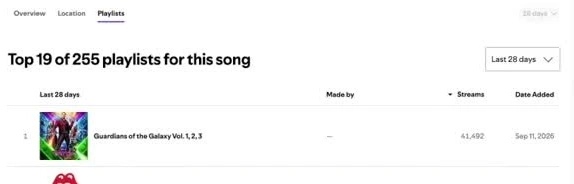
I pulled up a client’s song in Spotify for Artists. The Guardians of the Galaxy playlist showed about 40,000 streams. I changed one dropdown and the number jumped to 55,000. What did I change? The date range. That’s why, before I’d spend a dollar on playlist promotion, I’d want someone to show me exactly where their numbers come from.
An independent artist emailed me the questions that led to that walkthrough. He was planning to run Meta ads alongside playlist pitching, and he had a few countries he wanted to reach and a few he wanted to avoid. I liked his email because he asked for something I could actually show him: where the listeners came from, how we chose whom to pitch, and what he’d be able to see after he paid.
What should you ask before buying playlist promotion?
Ask who decides where your song goes, what the audience data actually measures, how long pitching takes, what happens to your money if no curator adds the song, and where you can check the streams yourself. A good provider can answer each one with specifics about your track. Be wary of any quote that guarantees a placement or promises one within a day or two.
Who decides where your song goes?
At IMA, we start with the song. We look for curators whose playlists fit the artist, the genre and the way the track feels. We pay particular attention to what I call legacy playlists. Some have been around for five or even ten years. What I like about them is how listeners find them: somebody opens Spotify, searches for a mood or a genre, and there’s the playlist. That discovery path is already there when we pitch.
We choose whom to pitch. The curator listens and decides whether the song belongs on one of their playlists. When you’re looking at a promotion quote, try asking, “Who would you pitch my track to, and why that person?” You’ll learn more from one thoughtful answer about your song than from a list of playlist logos.
One thing I’d listen for in the answer is how people get to the playlist in the first place. Say you make a quiet acoustic track. Try the search you think a listener would make when they want that sound. Open a playlist you find and listen to the tracks around where yours might sit. Could you hear your song coming on next? That little exercise gives you a much better question for a promoter: “What would someone be listening for when they find the list you have in mind?”
There’s a reason I care about the curator’s answer as much as the artist’s. Someone who’s spent years building a list has listeners who come back for a particular sound. Passing on a track they like personally can be the right call for that list. If a quote promises the exact playlist and the day you’ll appear, I’d want to know who made that decision and whether they’ve heard the track yet.
That’s also where I’d slow down on speed promises. I’ve seen sites advertise guaranteed placement within 48 hours. Real pitching takes time for a curator to listen and decide, so a promise like that makes me think the company is placing songs on lists it controls in exchange for your payment. Spotify’s own guidance on third-party promotion services says services that claim guaranteed playlist placement in exchange for money shouldn’t be used.
Why did one report say Brazil and another point to the U.S.?
When I looked up Guardians of the Galaxy in artist.tools, Brazil showed up as a top location. If you were trying to reach American listeners, you might cross that playlist off your list. I wanted to see what was happening for a song that was actually on it.
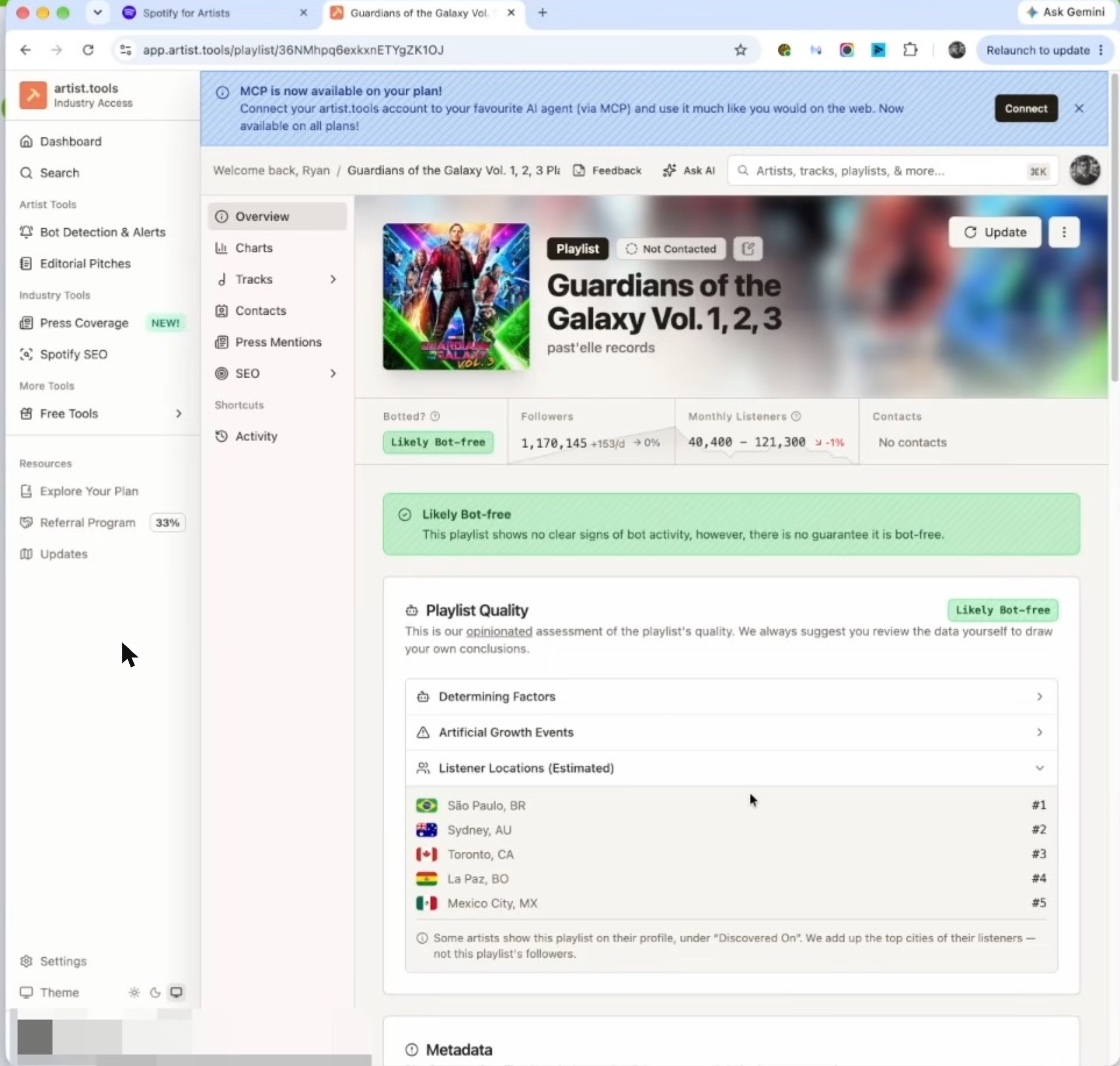
The estimate I showed in the video used audience data for the artists on the playlist. Think about the difference between “Where do people listen to Fleetwood Mac?” and “Where did people listen to my song?” I could check the second question in my client’s Spotify for Artists account. Guardians was driving most of that song’s playlist streams, and the U.S. led the countries I compared.
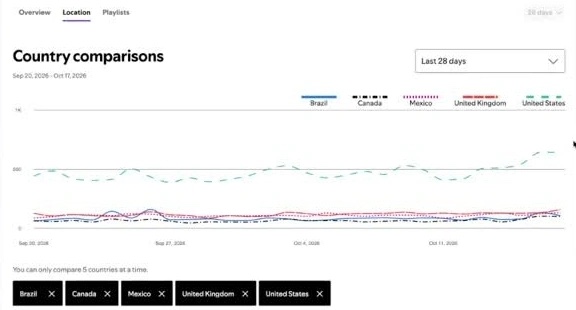
That gave me a better read on this particular release. I still couldn’t tell you where every listener on Guardians lived. When someone sends you an audience screenshot, start with a simple question: whose audience am I looking at?
Can a playlist reach U.S. listeners and still get streams in Brazil?
Yes. Brazil and Mexico showed up in that same client’s report. I think of it like radio. You can pick a station that reaches the area you care about, but you can’t choose which ZIP codes are allowed to tune in. Someone outside your target market can find a public playlist and press play.
If your goal is to reach more U.S. listeners, ask for a song-level example that shows how a similar pitch played out. If your release plan depends on excluding every other country, say that up front. A screenshot with the U.S. at the top answers only the first question.
I’d actually be more suspicious of the opposite. A busy playlist that people find through search will usually show a mix of countries, often with one country in the lead. In my experience, when nearly every stream on a playlist comes from a single country, that’s one of the clearest signs the listening isn’t real.
Where do Meta ads fit if you’re pitching playlists too?
The artist who wrote to me was asking one campaign to do two jobs. He wanted listeners to discover the song on playlists, and he wanted control over which countries saw his promotion. I’d split those decisions. For the pitch, I’d start with “Who already listens to this kind of track?” For the ad, I’d start with “Where do I want to spend my budget?”
Imagine your next show is in Chicago. A playlist listener in Mexico might save your single and come back for your next release. That’s a good outcome for the song. It tells you very little about whether the promotion reached somebody who could come to the show. I’d use the geographically targeted ad for the show and judge the playlist pitch on whether the song found listeners. That way a useful placement doesn’t look like a failure just because it did a different job.
If you run both at once, write down the ad start date and each placement date. When a spike appears, open the song’s playlist report before giving the whole lift to either campaign. You can see which streams Spotify attributed to a named playlist. The rest of the increase is still a question; subtracting the playlist number doesn’t prove that every remaining stream came from your ad.
How to check the streams behind a campaign report
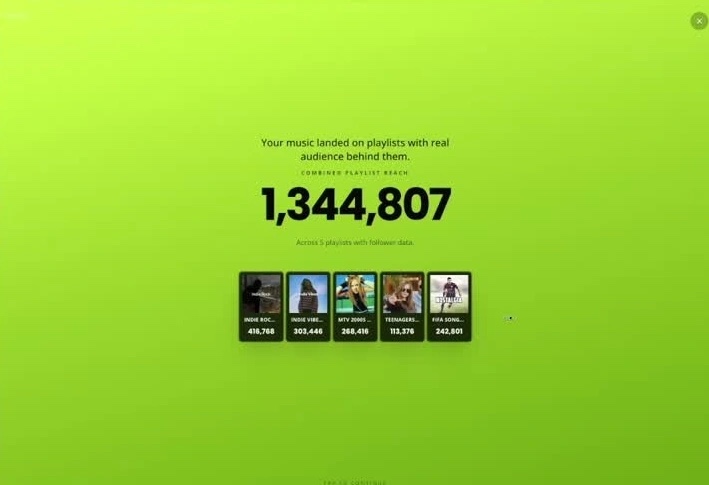
On our campaign report, reach adds up the follower counts of the playlists that picked up the song. If you want to know how many streams your track actually got from a placement, there’s a different number to look at.
Here’s how I checked the Guardians placement:
-
Open the song in Spotify for Artists, go to its playlist tab, and find the playlist by name. This is where I checked streams from Guardians specifically. The song’s overall total also includes people who found it elsewhere.
-
Check the date range before you write the number down. In the 28-day view I saw about 40,000 streams. In the 12-month view I saw about 55,000. The song had already been on Guardians for longer than four weeks.
Those extra 15,000 streams didn’t arrive while I was clicking around. The longer window included listening the shorter report left out. If two campaign updates look different, match the song, playlist and dates before deciding whether performance changed.
Here’s another number from the campaign recap I showed: the five playlists had more than 1.3 million followers between them. If I sent you just that figure, what would you put in your release notes? “My song gained 1.3 million followers” would be wrong. So would “1.3 million people heard my song.” The report added up the follower counts of the five lists. A listener could follow two, and somebody who follows a list might never have played your track.
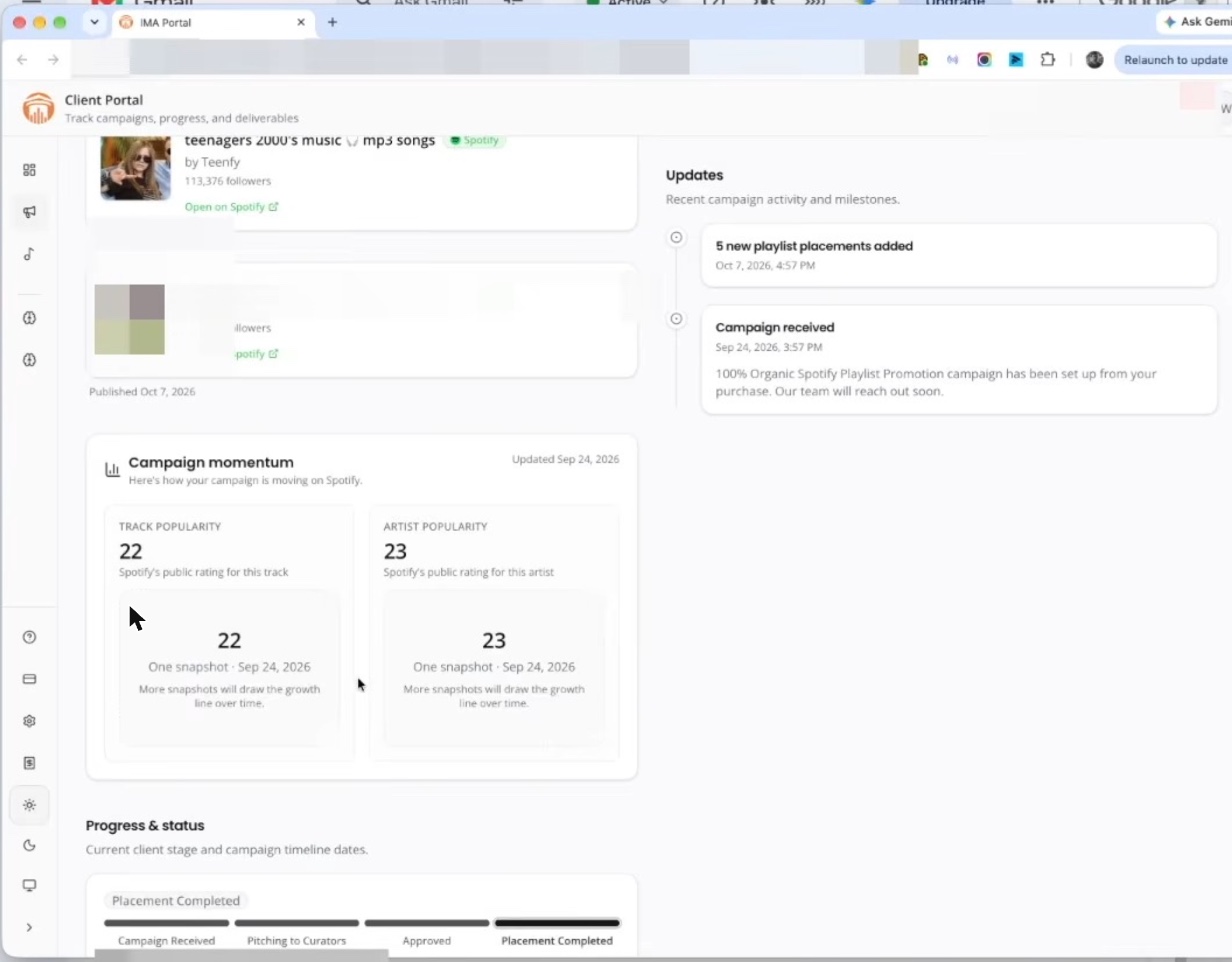
To retrace the campaign yourself, I’d start with the placement timeline in the IMA portal. Pick one playlist, note when your track appeared, then look it up under your song in Spotify for Artists. Now you can write something specific: which playlist picked up the track, when, and how many streams were attributed to it during the window you checked. That’s a number you can compare with another placement when you plan your next release.
The portal also snapshots your track popularity and artist popularity, the 0–100 scores Spotify reports for each. I treat them as a rough signal of momentum, so I like to see them over the life of a campaign rather than on a single day.
What happens if nobody picks up the song?
I’d ask this before paying. In the campaign I described, the pitching itself took around 14 days. Sending a song to a curator, getting a yes, and seeing it go live are three different moments. If you have a release date circled on your calendar, find out which of those dates the provider is quoting.
Here’s how I explained our terms in the video: if we couldn’t get a campaign rolling at all, we offered a full refund. If we missed the campaign goal, we offered a partial refund for the shortfall. For the quote in front of you, get the goal and the refund calculation in writing. “What would happen to my payment if every curator passed?” is a fair question.
There’s also a timing question that can get lost in the refund conversation. A curator may like the song today and add it when they next refresh their list. The curators we work with usually refresh about once a month rather than adding one track a day. If you need something to happen on release Friday, work backward: when can the curator hear the preview, when do they normally update, and what happens if their next update is the following week? You can decide whether that timing still works for your release before you spend the money.
Your checklist before paying
-
Process: Which curators would you approach, why does my song fit, and who makes the final placement decision?
-
Audience: What geography evidence can you share, and what does that report actually measure?
-
Timing: What are the expected pitching and campaign dates, and what must I supply before release day?
-
Terms: What is the current price, how is the goal defined, and what happens if the campaign doesn't start or falls short?
-
Reporting: Where can I check placements and playlist stream counts, and how do you define each reported metric?
-
Red flags: Does the quote guarantee a placement, promise one within a day or two, or show an audience that comes almost entirely from one country?
Frequently asked questions
Which reporting window should I use for a campaign lasting several months?
Start with the placement dates. In my example, the last 28 days cut off part of the run, so I opened the 12-month view. For your own report, pick the window that covers the period you’re trying to measure and write those dates next to the total.
What should I prepare before asking about release-day promotion?
Have your release date and a playable preview link ready. For the release-day pitches I described, we needed the preview 14 days ahead. A SoundCloud or Dropbox link was enough for a curator to listen before the song came out. Check the deadline for your campaign while you still have time to meet it.
Does a curator saying no mean my song is bad?
No. A curator is deciding whether the song works for the people who come to that particular playlist. I want curators to be able to pass for exactly that reason. If they gave feedback, read it with the playlist in mind before you change anything about your track.
Is a guaranteed playlist placement a red flag?
Yes. Spotify says services that claim guaranteed playlist placement in exchange for money shouldn’t be used. A curator who actually listens can say no, so an honest provider can promise a pitch and a refund policy, not a placement.
For the original walkthrough, watch You need to know this before Spotify Playlist promotion. Your next step: take the promotion quote you're considering and fill in the checklist before you pay. If you’d like us to pitch your song, here’s how our Spotify playlist promotion works.