
How I Use artist.tools to Evaluate Spotify Playlists
My practical workflow for reviewing Spotify playlists in artist.tools: growth history, warning signs, follower dips and discovery context.
To evaluate a Spotify playlist with artist.tools, start with its playlist report, examine the historical follower graph, investigate unusual drops and rebounds, and ask how real listeners discover it. A warning badge or a follower dip is a reason to investigate—not proof that a playlist uses bots.
Playlists can introduce your music to new listeners. But a large follower number does not tell you whether a playlist is a good place for your song. When my team and I encounter a playlist we have never worked with before, artist.tools helps me ask better questions about its history.
This is the workflow I demonstrated in “How I avoid FAKE Spotify playlists (Artist.Tools Walkthrough & Review).” I am not using every feature in the product. My focus is the playlist report and the patterns I look for before taking a playlist seriously.
Disclosure: At the time of recording, I paid for my own artist.tools subscription. The video was not sponsored.
1. Start with the exact Spotify playlist URL
I copy the Spotify playlist URL into the search bar in artist.tools and open the full playlist report. Using the exact URL helps avoid confusing two playlists with similar names.
Before interpreting the chart, I check which playlist I am looking at and who curates it. An independent playlist and a Spotify-owned playlist can have very different histories. That context matters when their growth lines behave differently.
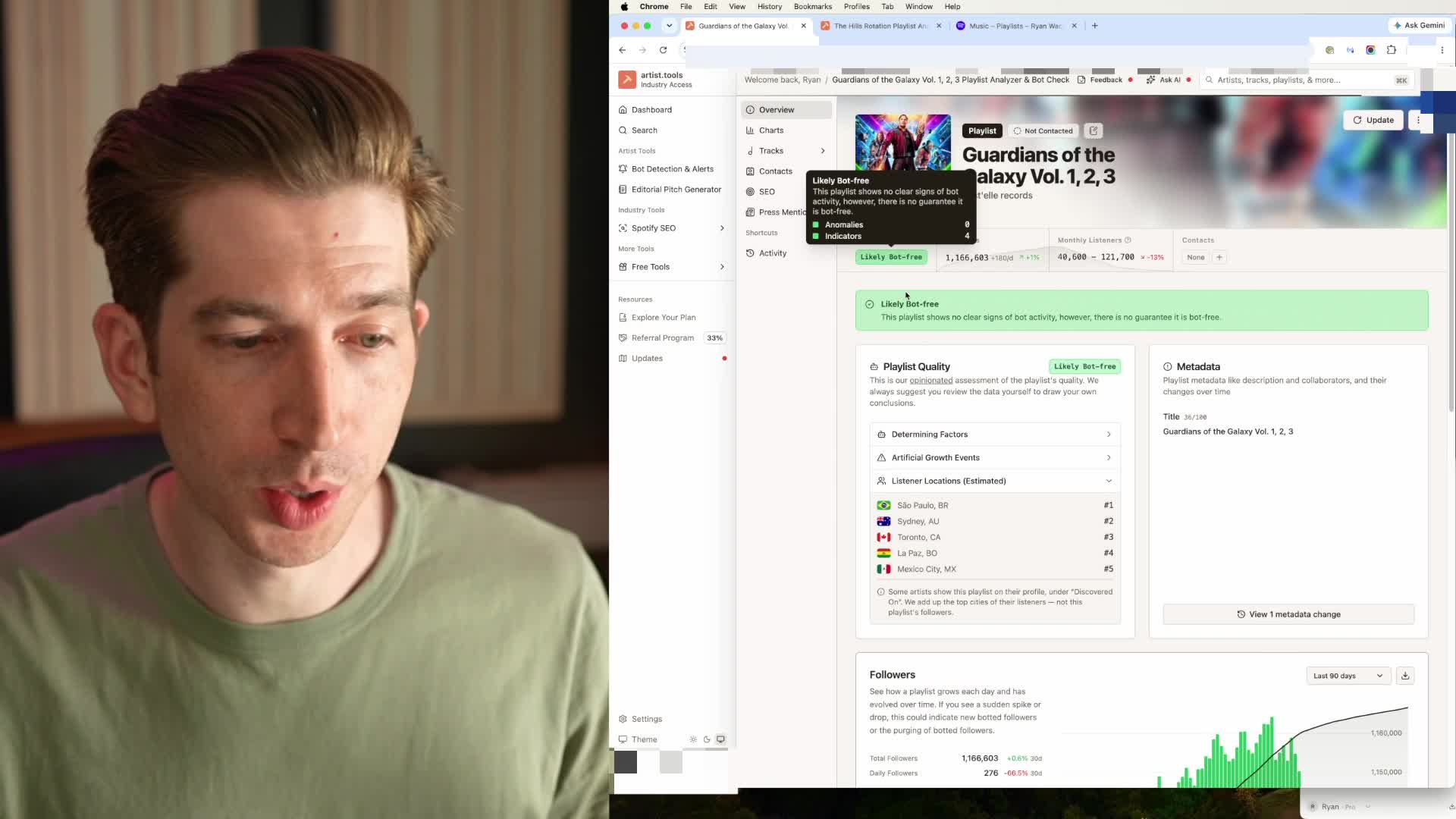
In the walkthrough, I use a Guardians of the Galaxy playlist as an example. The report shown in the recording has a “Likely Bot-free” badge. The tool’s own explanation also says that this is not a guarantee. I treat the badge as an initial assessment, then look at the underlying evidence.
2. Look beyond the current follower count
The historical follower graph is one of the most useful parts of my review. I expand the date range to see how the playlist developed over time instead of judging it from a single number or a short window.
In the recording, the Guardians example has a generally upward growth line. That is encouraging to me because I want to understand whether a playlist continues to attract an audience. It does not establish that every follower is authentic or that my song will receive a particular number of streams.
-
Look at the overall direction over a meaningful period.
-
Notice whether growth is gradual, uneven or concentrated in sudden jumps.
-
Zoom in on unusual events, then zoom back out to see whether they change the wider pattern.
-
Record what you can observe separately from what you think caused it.
That last distinction matters. A chart can show that followers fell on a certain day. It usually cannot, by itself, establish exactly why they fell.
3. Investigate repeated drops followed by rapid rebounds
A pattern that makes me pause is a large follower drop followed by an unusually fast recovery, especially when that cycle repeats. In the video, I contrast that kind of pattern with steadier growth.
My concern is whether the headline follower number is being artificially maintained. But the graph is a signal for further investigation, not a verdict about a curator. I want corroborating information before drawing a conclusion.
Rather than asking only “Did this playlist lose followers?”, I ask: How large was the change relative to the playlist? Has this happened repeatedly? How quickly did the number recover? Is there a plausible explanation for new listeners finding it?
If I cannot explain the pattern with enough confidence, I do not treat the playlist’s follower count as reliable evidence of its value.
4. Put follower dips in context
One of the most important examples in the walkthrough is Spotify’s Today’s Top Hits. Its report shows follower losses and warning markers during the period I review. Those marks alone are not enough to conclude that a playlist has an artificial audience.
Comparing reports helps me avoid a simplistic rule that every downward movement means something is wrong. A change can be worth investigating without justifying an accusation. Similar timing across playlists can prompt questions about broader changes, but it does not confirm their cause.
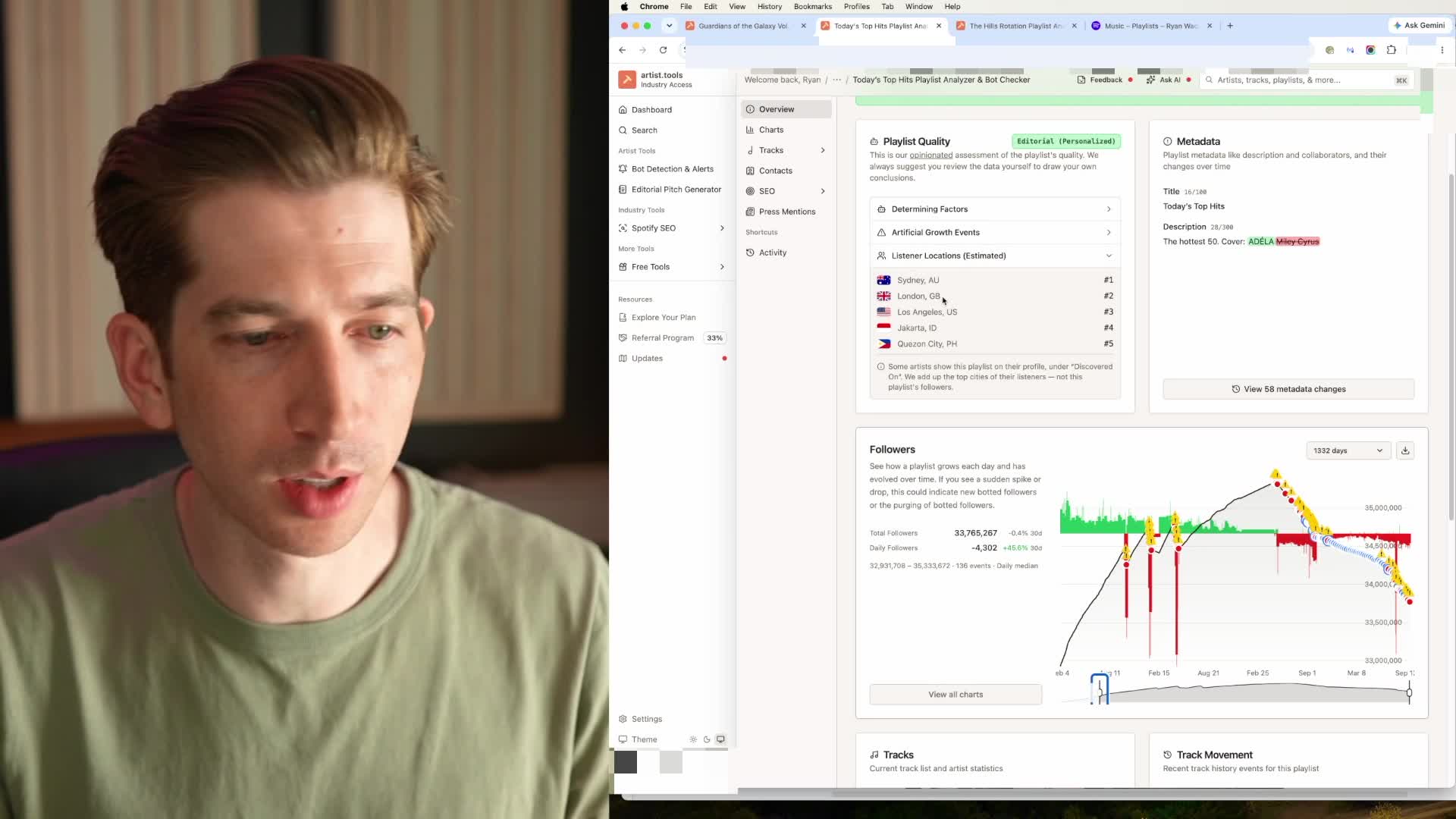
In the video, I discuss possible explanations involving account cleanups and changes in discovery. Those are interpretations of the chart. This article does not establish the cause of a particular drop or claim to know Spotify’s internal promotion decisions.
5. Ask how real listeners find the playlist
After looking at the numbers, I ask a practical question: How would someone discover this playlist? In the walkthrough, I discuss Spotify search as one possible route and use the Guardians example to explain my thinking.
Search visibility can help explain growth, but it is not a complete authenticity test. A playlist might also attract listeners through its curator’s audience or other promotion. If I do not see an obvious discovery route, that is a question to investigate—not proof that the audience is fake.
The goal is to connect the growth pattern to a plausible story about real listeners. A big number is less useful when I cannot understand what sits behind it.
A checklist for your next playlist review
-
Confirm the exact playlist and curator.
-
Read the report’s assessment and its limitations.
-
Expand the historical follower graph.
-
Inspect significant drops, jumps and repeated rebounds.
-
Compare the pattern with other relevant playlists without assuming a shared cause.
-
Ask how listeners discover the playlist.
-
Keep observations, interpretations and unanswered questions separate.
-
Do not turn a badge or a chart into a guarantee of safe placement or future results.
Common questions
Does a follower drop mean a Spotify playlist uses bots?
No. A drop is a change to investigate. On its own, it does not establish why followers disappeared or whether the playlist has an artificial audience. In my review, the pattern over time and the surrounding context matter more than one event.
Does a “Likely Bot-free” badge guarantee the playlist is safe?
No. In the report shown in my recording, artist.tools explicitly qualifies that assessment. I use it to guide my review, alongside the historical data and my own questions about the playlist.
What does artist.tools help me decide?
It helps me decide which playlists deserve a closer look and which claims need more evidence. It does not replace judgment, guarantee a placement’s quality or predict the results a particular song will receive.
Make a better-informed playlist decision
My main takeaway is simple: understand the pattern before trusting the number. I want to see how a playlist has grown, what happens around unusual events and how its audience might be finding it. artist.tools makes those questions easier to investigate.
Explore Indie Music Academy for more guidance on building your audience as an independent artist.


